
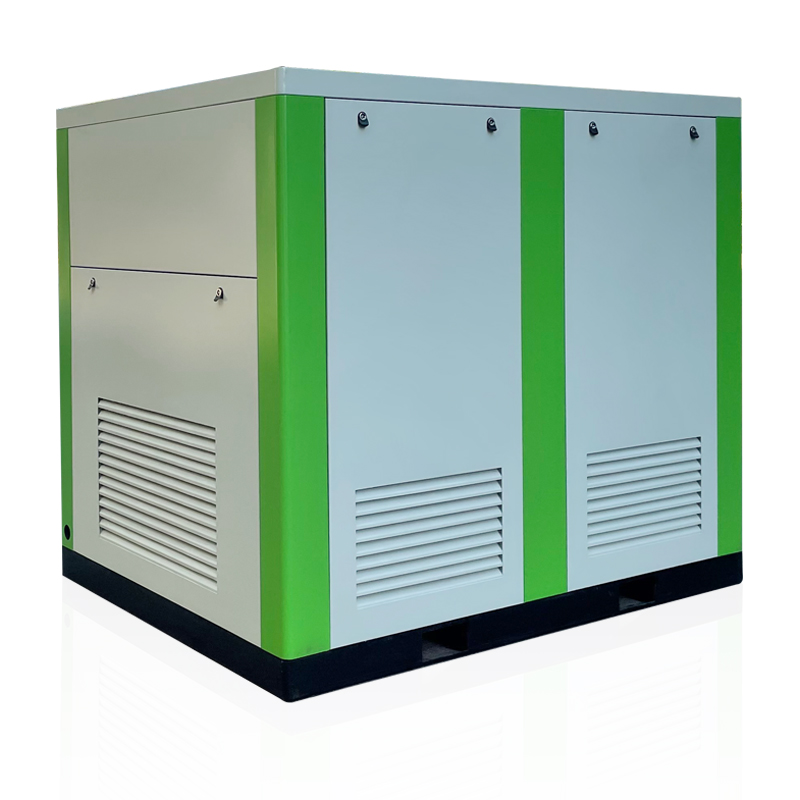
Structure:
Oil-free scroll air compressors have a simpler structure with fewer parts and a smaller size due to the relative motion of the moving and stationary scroll plates. Oil-free piston air compressors, on the other hand, use a belt-driven crankshaft and connecting rod structure for reciprocating motion, resulting in a more complex structure with more parts and a larger size.
Weight:
Oil-free scroll air compressors use high-strength aluminum alloy for major components, with a single unit weighing as little as 20kg. Oil-free piston air compressors use cast iron for major components, with a main unit weighing no less than 100kg.
Vibration and Noise:
Oil-free scroll air compressors undergo rigorous dynamic balancing testing, have high speeds, low airflow pulsation, no contact between the moving and stationary scroll plates, and no intake or exhaust valves. Noise levels at 1 meter are 65-75dB. Oil-free piston air compressors, however, have pistons in contact with the cylinder wall, resulting in greater reciprocating inertial forces. They also have intake and exhaust valves, where the valve plate impacts the valve seat, leading to noise levels of 80-90dB at 1 meter.
Exhaust Speed:
Oil-free scroll air compressors have four compression stages, resulting in a small pressure differential, minimal leakage, and a relatively fast exhaust speed. In contrast, oil-free piston air compressors have a two-stage compression stage, leading to a large pressure differential, significant leakage, and a slow exhaust speed.
Maintenance and Reliability:
Oil-free scroll air compressors have no intake or exhaust valves, and the moving and stationary scrolls do not contact each other, resulting in no wear and tear. They also have no vulnerable parts, a simple structure, fewer parts, easy maintenance, and low cost. Furthermore, being certified oil-free, they have a longer service life. Oil-free piston air compressors, on the other hand, have intake and exhaust valves and other vulnerable parts. The piston and cylinder wall come into contact and rub against each other, leading to rapid material wear. Their complex structure, numerous parts, and difficult maintenance result in higher costs. Additionally, over time, they may accumulate trace amounts of oil, shortening their service life.