
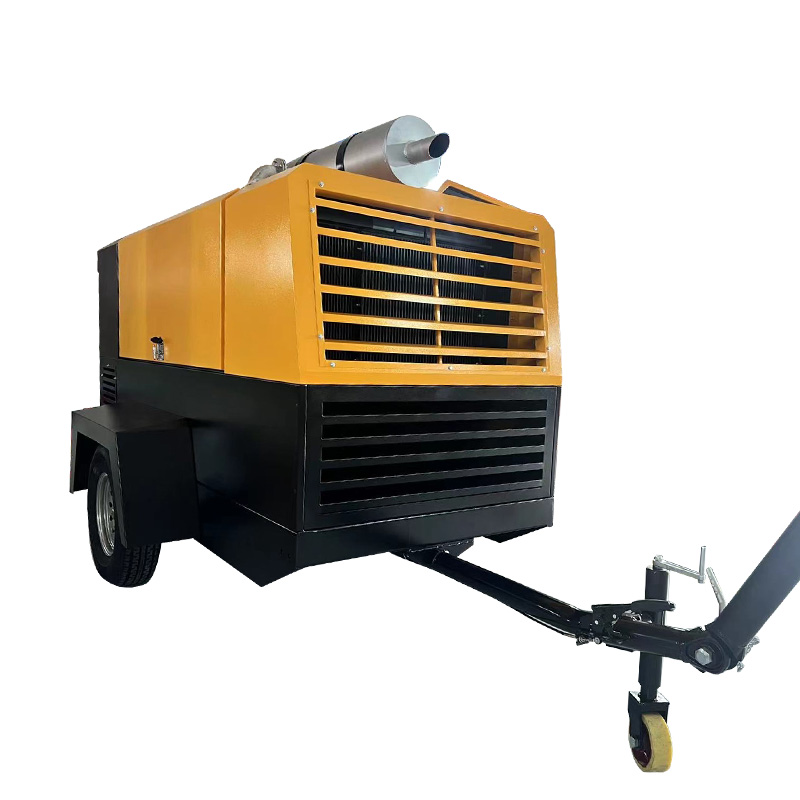
Common causes of severe overheating in air compressor motors include:
1. Insufficient air gap between the stator and rotor, easily leading to contact between them.
In medium and small motors, the air gap is typically 0.2mm to 1.5mm. A large air gap requires a large excitation current, thus affecting the motor's power factor; a too-small air gap may cause friction or collision between the rotor and the motor. This is generally caused by severely out-of-tolerance bearings and wear and deformation of the end cover's inner bore, leading to misalignment of the frame, end cover, and rotor, causing rotor rubbing and easily resulting in motor overheating or even burnout. If bearing wear is found, it should be replaced promptly. The end cover should be replaced or re-plated. A simpler solution is to insert a sleeve into the end cover.
2. Abnormal vibration or noise from the motor can easily cause it to overheat.
This type of vibration is caused by the motor itself, mostly due to poor rotor dynamic balance, faulty bearings, bent shaft, misalignment of the end cover, frame, and rotor, loose fasteners, uneven foundation, or improper installation. It could also be transmitted from the mechanical end. The specific cause should be addressed.
3. Malfunctioning bearings will inevitably cause the motor to overheat. Whether a bearing is functioning properly can be judged by sound and temperature.
You can use your hand or a thermometer to check the temperature of the bearing end to see if it is within the normal range. Alternatively, you can use a listening rod (copper rod) to touch the bearing housing. If you hear an impact sound, it indicates that one or more balls may have broken. If you hear a hissing sound, it indicates insufficient lubrication. The grease should be changed approximately every 3,000 to 5,000 hours of motor operation.
4. High power supply voltage increases the excitation current, causing the motor to overheat.
Excessive voltage can damage the motor insulation, posing a risk of breakdown. When the power supply voltage is too low, the electromagnetic torque decreases. If the load torque does not decrease, the rotor speed will be too low, leading to increased slip and motor overload, which will cause overheating. Prolonged overload will affect the motor's lifespan. When the three-phase voltage is unbalanced, i.e., one phase voltage is too high or too low, it will cause excessive current in that phase, resulting in motor overheating and reduced torque, producing a "humming" sound. Over time, this will damage the windings.
In short, whether the voltage is too high, too low, or unbalanced, it will increase the current, causing the motor to overheat and damage it. Therefore, according to national standards, the variation in motor power supply voltage should not exceed ±5% of the rated value, and the motor output power should remain at the rated value. The motor power supply voltage is not allowed to exceed ±10% of the rated value, and the difference between the three-phase power supply voltages should not exceed ±5% of the rated value.
5. Winding Short Circuit, Inter-turn Short Circuit, Phase-to-phase Short Circuit, and Winding Open Circuit
When the insulation between two adjacent conductors in a winding is damaged, causing the two conductors to come into contact, it is called a winding short circuit. A winding short circuit occurring within the same winding is called an inter-turn short circuit. A short circuit between two phase windings is called a phase-to-phase short circuit. Regardless of the type, it will increase the current in one or both phases, causing localized heating and damaging the motor due to insulation aging. A winding open circuit refers to a fault caused by the stator or rotor windings of the motor breaking or burning out. Both short circuits and open circuits can cause the motor to overheat or even burn out. Therefore, in such cases, the machine must be stopped immediately for repair.