
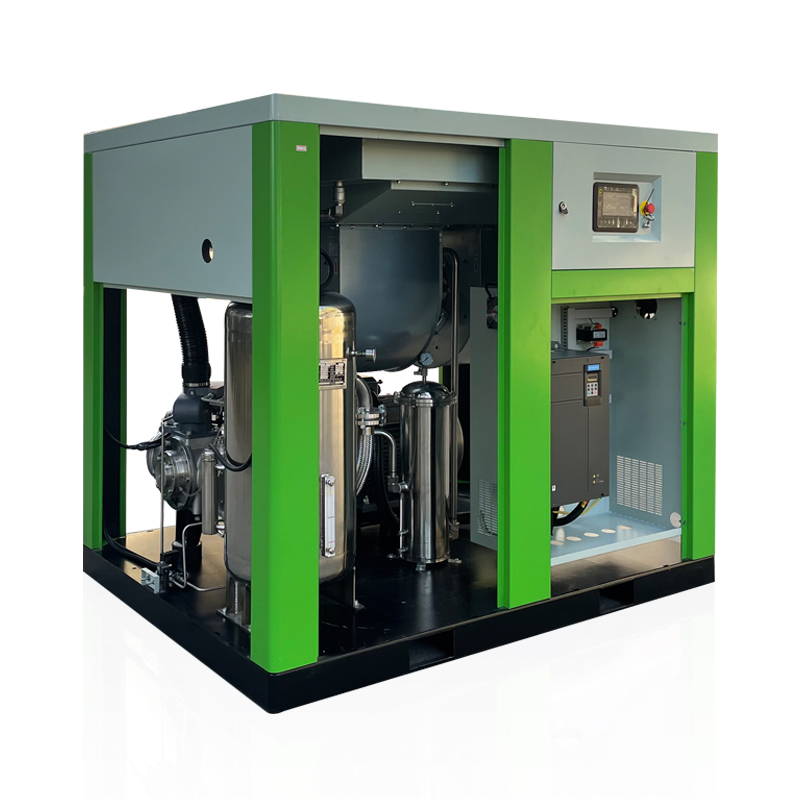
Reciprocating compressors convert the rotational motion of the driver into the reciprocating motion of the piston through a crank-connecting rod mechanism to compress and discharge gas.
Advantages:
1. Wide pressure range. Because it works based on the principle of volume change, the working pressure is very high. Industrial ultra-high-pressure compressors can reach working pressures of up to 350 MPa.
2. The equipment is relatively inexpensive, easy to operate, and has a long service life.
3. Due to the closed compression process, the thermal efficiency is relatively high.
4. Wide range of discharge volume, less affected by changes in discharge pressure.
Disadvantages:
1. Large inertial force, low speed, and the machine is relatively bulky.
2. The structure is relatively complex, with many wear parts, resulting in higher maintenance costs.
3. Discontinuous exhaust, pulsating airflow pressure, and prone to gas column vibration.
4. High vibration and noise during operation, making equipment installation difficult. Furthermore, because reciprocating compressors can only intermittently intake and exhaust gas, the cylinder volume is small, and the speed cannot be too fast, thus limiting the discharge volume and power output of the reciprocating compressor.
Scope of Application:
Reciprocating compressors are mainly suitable for small to medium flow rates and high-pressure applications. Therefore, the development direction of reciprocating compressors is mainly towards large capacity, high pressure, low noise, high efficiency, and high reliability.