
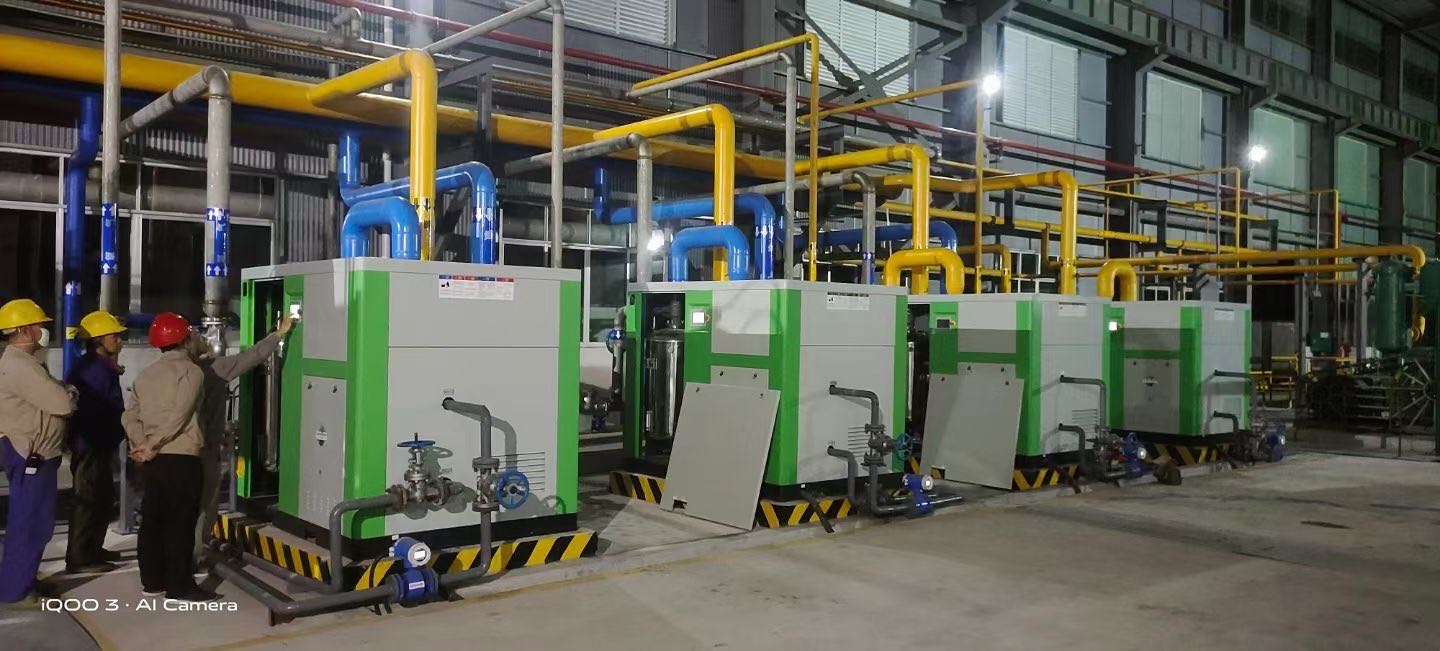
To calculate the potential for energy recovery in a compressor system, one must first understand the specific compressor model, power rating, operating hours, and cooling method (air-cooled or water-cooled). The following outlines the basic calculation steps:
Determine Compressor Power and Operating Hours:
Assume the compressor power is P (in kW) and the annual operating time is T (in hours).
Estimate Waste Heat Generation:
The waste heat generated during the compression process is related to the compressor's efficiency; however, as a general rule, it can be roughly estimated as a certain percentage of the compressor's power output (e.g., 80%–90%), since not all electrical energy is converted into thermal energy.
Waste Heat Generated Q (in kWh) = P * T * 0.85 (assuming 85% of the electrical energy is converted into thermal energy).
Assess Recovery Efficiency:
Based on the specific recovery technology employed (e.g., hot water recovery, thermal power generation, etc.), estimate the proportion of waste heat that can be recovered. For instance, if a hot water recovery system is utilized, the recovery efficiency might reach 94%.
Recoverable Waste Heat Q_recycled (in kWh) = Q * Recovery Efficiency.
Calculate Economic Benefits:
Based on the amount of recovered waste heat and local energy prices (e.g., the monetary value of 1 kWh of hot water), calculate the annual energy cost savings.
Additionally, consider the investment costs, maintenance costs, and the payback period (time required to recoup the investment) for the recovery system.
How is Energy Recovered in Air-Cooled Systems?
Air-cooled compressors dissipate the heat generated during compression into the surrounding air via a fan. Recovering this specific portion of energy is relatively more challenging, yet several methods can still be attempted:
Heat Recovery Heat Exchangers:
Install a heat recovery heat exchanger at the compressor outlet to utilize the principles of heat exchange, transferring the thermal energy from the compressed air to circulating water or another medium.
By adjusting the flow rate and temperature of the circulating water, one can control the amount of recovered thermal energy and the resulting hot water temperature.
**Air-Source Heat Pumps:
Utilize the hot air discharged by the compressor as the low-temperature heat source for a heat pump; through heat pump technology, the quality (temperature level) of the thermal energy is upgraded for use in space heating or hot water supply.
Direct Utilization:
In certain specific applications—such as greenhouses or drying rooms—the hot air discharged by the compressor can be directly channeled indoors for use in heating or drying processes.
How is Energy Recovered in Water-Cooled Systems? Water-cooled compressors dissipate heat through a cooling water system; recovering this energy is relatively easy and highly efficient:
Closed-Loop Hot Water Recovery:
By installing a heat recovery device (such as a plate heat exchanger) within the cooling water circuit, thermal energy from the cooling water can be transferred to water in a separate circulation system, to be utilized for space heating or hot water supply.
This method helps maintain the cleanliness and stability of the cooling water system while simultaneously enhancing energy recovery efficiency.
Thermal Power Generation:
For large-scale water-cooled compressor systems, the recovered waste heat can also be used to drive power generation units—such as an Organic Rankine Cycle (ORC) system—thereby converting thermal energy into electrical energy.
While this approach requires a significant initial investment, it enables a higher level of energy utilization and yields greater economic benefits.
Multi-Purpose Thermal Energy Utilization:
The recovered hot water can be utilized for a wide variety of applications—beyond just space heating or hot water supply—including process heating, cleaning operations, and other industrial uses, thereby further maximizing energy utilization efficiency.