
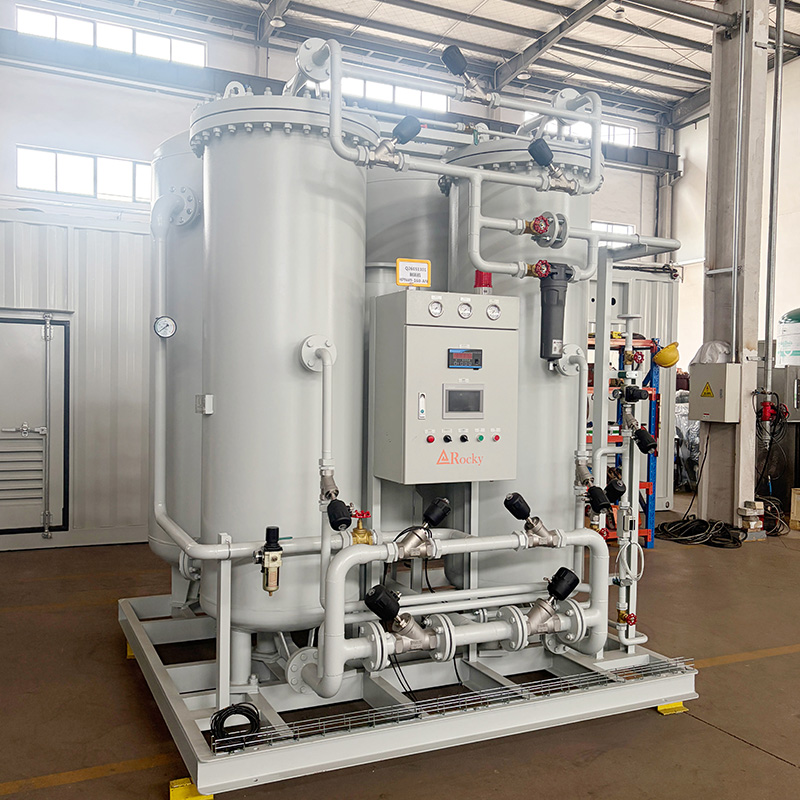
99.5% high-purity oxygen is a grade of oxygen with a purity level exceeding 99.5%, widely used in medical, industrial, and scientific research fields. Compared to standard industrial oxygen, 99.5% high-purity oxygen is subject to stricter requirements regarding gas composition and impurity levels; consequently, more sophisticated technical methods are employed during its production.
I. Technical Characteristics of 99.5% High-Purity Oxygen
High Purity Standards
99.5% high-purity oxygen meets a purity standard of over 99.5%, a much stricter requirement than that for standard industrial oxygen (typically ranging from 90% to 95%). To achieve this standard, production processes utilize highly efficient separation technologies—such as molecular sieve adsorption, membrane separation, and gas cooling—to remove nitrogen, argon, and other harmful components from the oxygen.
Production Process
The production of 99.5% high-purity oxygen typically begins with air separation. Compressed air is processed using techniques like molecular sieve adsorption or cryogenic cooling to remove impurities such as nitrogen, carbon dioxide, and moisture. In molecular sieve adsorption, specific materials (e.g., molecular sieves, activated carbon) are used to selectively adsorb impurities, resulting in high-purity oxygen. To enhance yield and purity, some manufacturers employ multi-stage separation equipment, ensuring that gas purity meets requirements at every stage of the process.
High-Purity Gas Testing
Strict gas testing is conducted during production to ensure the quality of 99.5% high-purity oxygen. Common testing methods include gas chromatography and mass spectrometry; these techniques accurately analyze gas composition and verify that purity exceeds 99.5%. Additionally, impurity levels (such as nitrogen, argon, and carbon dioxide) are strictly controlled to ensure they do not exceed specified maximum permissible limits.
Storage and Transportation
High-purity oxygen imposes stringent requirements for storage and transportation, necessitating the use of specialized high-purity gas cylinders, steel cylinders, or gas tanks. To prevent contact between oxygen and impurities, stainless steel cylinders and specialized gas delivery systems are typically employed; these systems effectively prevent contamination and maintain the oxygen's high purity.
II. Application Areas of 995 High-Purity Oxygen
Medical Industry
995 high-purity oxygen finds its most extensive application in the medical sector. Because it effectively raises blood oxygen levels, it is clinically used to treat conditions such as hypoxia, respiratory failure, and acute altitude sickness. Notably, it serves as a key component in hyperbaric oxygen (HBO) therapy, where it accelerates wound healing, alleviates carbon monoxide poisoning, and promotes cellular repair.
Metal Smelting and Welding
In the metal smelting and welding industries, 995 high-purity oxygen is frequently used as a combustion aid. Oxygen raises combustion temperatures, facilitating metal melting and welding processes. Its use improves weld quality and minimizes the formation of impurities, making it particularly suitable for high-precision welding techniques and the welding of special alloys.
Electronics Industry
The electronics industry imposes strict requirements on gas purity; 995 high-purity oxygen is primarily utilized here in semiconductor manufacturing. During semiconductor fabrication, oxygen often serves as a carrier gas in chemical vapor deposition (CVD) processes, allowing for precise control over oxidation reactions. Additionally, it is used to clean and prepare critical components, ensuring surfaces remain free of contaminants.
Aerospace
In the aerospace sector, high-purity oxygen is commonly used in rocket propulsion systems and for supplying oxygen to aircraft. Since oxygen purity directly impacts propulsion efficiency and equipment safety, 995 high-purity oxygen ensures more stable propulsion performance. It is also utilized in spacecraft life-support systems to ensure astronauts can breathe normally while in space.
Chemical Reactions and Synthesis
995 high-purity oxygen is widely used in the chemical industry, particularly in synthesis, oxidation, and hydrogen production. In certain high-temperature reactions, oxygen acts as an oxidizing agent, effectively increasing reaction rates and enhancing product purity.