
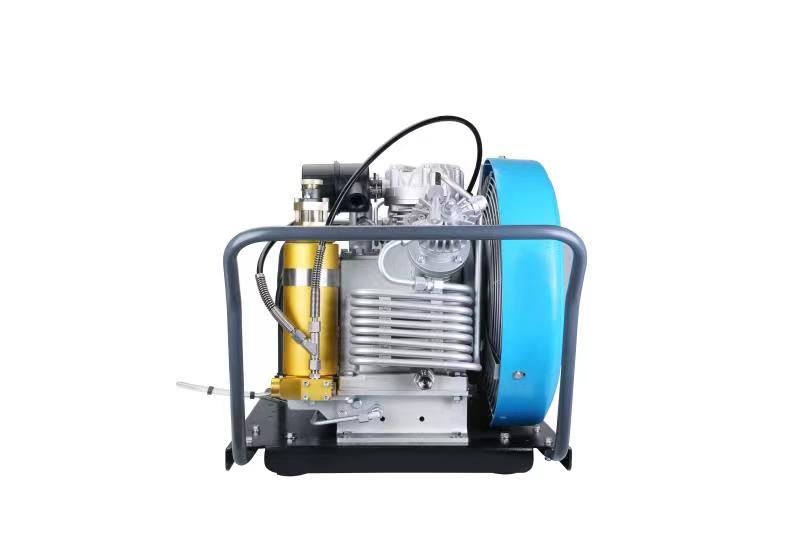
Primary Uses and Functions of Air Compressors in Biopharmaceutical Industry: In the biopharmaceutical industry, compressed air is generally used in filling machines for liquid preparations, granulators, slurries, filling machines, packaging machines, and printing machines for solid preparations. It is also used in acquisition tanks in pharmaceutical technology. Furthermore, it is used for laboratory testing, powder material conveying, drying, material blowing and purging, pneumatic surface components, and automatic control of air.
In the pharmaceutical industry, compressed air compressors come into direct contact with pharmaceuticals. Therefore, it is essential to maintain the cleanliness of the compressed air compressor. It must undergo purification treatment and pass standard inspections to ensure it meets production requirements and must also pass GMP certification. For preparation air used in drying, pressing, etc., it is necessary to control the content of oil, water, solid particles, and biological particles in the compressed air, and it is also required to be odorless.
Surface-use air primarily refers to air used in pneumatic surfaces and precision (pressure, flow) regulators. Except for the lack of control over biological particles and the absence of an odor-free requirement, other control items are the same as for pharmaceutical preparation air. The quality standards for surface-use air can be found in GB/T13277 "General-Purpose Compressed Air Quality Grades". The general requirements for pharmaceutical preparation air quality are as follows: The compressed air used in manufacturing and technical operations, including sterilization, should be:
(1) supplied by an oil-free air compressor, oil-free and free of oily gases, and discharged outside uncontrolled environmental areas.
(2) To prevent condensation in the pipeline, the air must be dehumidified. Features and Working Principle of Screw Air Compressors Screw air compressors are a new type of air compressor, used for less than 20 years. They differ significantly from traditional air compressors, boasting advantages such as novel structure, small size, light weight, low noise, long lifespan, stable and continuous air delivery, simple operation, and low maintenance costs. They are known in the industry as "repair-free air compressors" and "newly modified air compressors," and are the preferred model for air compressors under 50HP, especially in the pharmaceutical industry. A screw air compressor consists of two meshing, rotating and stationary scroll plates with a double-function equation profile. During the intake, compression, and exhaust processes, the stationary plate is fixed to the frame, while the rotating plate, driven by an eccentric shaft and restrained by an anti-rotation mechanism, rotates around the base circle of the stationary plate, performing planar tumbling with a very small radius. Gas is drawn into the periphery of the stationary disc through the air filter element. Following the rotation of the eccentric shaft, the gas is gradually compressed within several crescent-shaped compression chambers formed by the engagement of the dynamic disc, and then continuously discharged through the axial holes of the stationary disc base component.
Features of Screw Air Compressors:
I. High Reliability. 1) Screw air compressors have fewer main components than piston compressors, only 1/8 the number. This significant reduction in parts is a key factor in improving reliability. 2) Small radius of rotation and a linear velocity of only 2m/s result in less wear, higher mechanical efficiency, and less vibration. 3) A scientifically controlled overall system further ensures improved stability.
II. Lowest Noise. 1) The absence of intake and exhaust valves and complex motion mechanisms eliminates the knocking sound of valve plates and the explosive sound of airflow, drastically reducing noise. 2) Continuous and stable intake and exhaust, exceeding 6000 times per minute, minimizes airflow pulsation. 3) A single 20HP (15KW) screw air compressor produces only 62dBA of noise, allowing it to be used anywhere, saving significant equipment costs and better meeting environmental protection requirements.
III. Lowest Energy Consumption. 1) Due to the intake boosting effect and the absence of clearance volume, the volumetric efficiency of the screw air compressor is over 98%. 2) Because multiple working chambers compress gradually, the pressure difference between adjacent working chambers is very small, resulting in minimal leakage. A single compression process involves several compression cycles, leading to high thermal efficiency. 3) With no intake or exhaust valves, the resistance to intake and exhaust is virtually zero. The absence of friction and wear from moving parts results in high mechanical efficiency, a key factor in the screw air compressor's significant energy savings compared to other air compressors. For example, a single 20HP (15KW) screw air compressor operating for 6000 hours per year can save up to 18,000 yuan in electricity costs.
IV. Lowest Maintenance Costs. With fewer main components and even fewer easily damaged parts, the likelihood of parts replacement is significantly reduced. This eliminates the need for long replacement cycles, ensures ease of use, minimizes maintenance workload, and lowers maintenance costs.
V. 100% Oil-Free Compressed Air. Only oil-free air compressors can produce oil-free compressed air. Whether production activities occur in pharmaceuticals, food processing, precision electronics, or similar industrial settings, safety is paramount. This is why oil-free compressed air solutions are chosen; oil-free air compressors are used in applications requiring high-purity compressed air. No oil means no danger, no risk of pollution, no risk of product damage or safety issues, and no losses due to production stoppages. In short, no oil means no risk of damaging hard-earned reputation.