
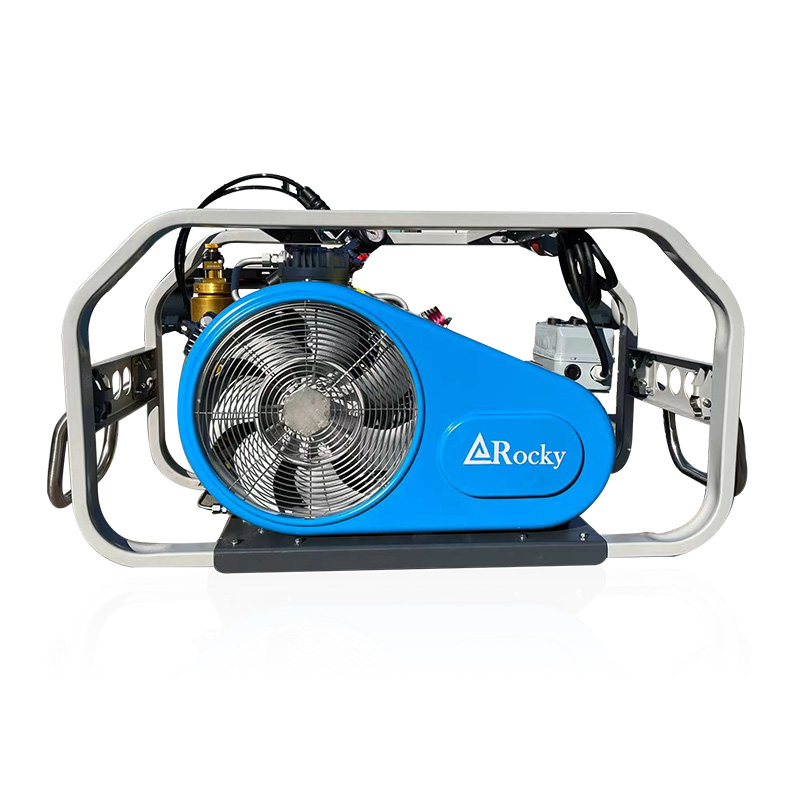
The air compressor market has a significant demand for motors, yet the requirements placed on these motors are stringent. Today, let’s discuss some of the specific requirements air compressors impose on their motors.
By comparing designs based on constant power versus constant displacement—and understanding their respective operating principles—we can gain insight into the "service factor" of screw air compressors. Next, let’s look at screw air compressors and their modes of operation.
Air compressors generate compressed air; however, unlike the flow of a river, the speed of compressed air cannot be directly observed. Instead, changes in air volume are reflected through fluctuations in pipeline network pressure. In other words, pressure changes indicate shifts in the supply and demand of air volume; pressure fluctuation is the observable phenomenon, while the change in air volume is the underlying reality.
For air compressors, the motor load fluctuates cyclically based on the user's air demand. When the system reaches the user-set maximum operating pressure, the compressor enters an "unloaded" state; typically, the motor power consumption of a standard fixed-speed screw compressor during this unloaded phase is 30%–45% of its full-load power. When the network pressure drops to the user-set minimum, the compressor automatically re-loads. Consequently, the actual time spent operating at full load (near maximum pressure) is quite brief.
In my country, screw air compressors emerged in the early 1990s to become the dominant type of equipment in the industry. Their intelligent control capabilities have advanced significantly alongside developments in the computer and electronics sectors; this enhanced intelligence ensures safer and more stable operation.
In summary, regardless of the design scheme or operating mode, the ideal approach to motor selection is to ensure the motor operates at peak efficiency and with a high power factor. Motor capacity ratings are discrete, non-continuous values, whereas the calculated motor load often falls somewhere between these discrete steps.
According to mechanical design handbooks, the standard method for selecting motor power is to multiply the shaft power by a factor of 1.1, ensuring the motor's rated power is at least equal to this calculated value. Selecting motor power using this method does not account for the "service factor." When applied to motors for screw air compressors, the result is relatively low motor efficiency and power factor, leading to a waste of energy and increased costs.
Effectively utilizing the motor's "service factor" and ensuring operation within specified, reasonable limits is a pressing issue that the screw air compressor industry must address.
Furthermore, twin-screw air compressor airends inherently generate unbalanced axial and radial forces—resulting from the gas compression process—that act upon the rotors. With gearless drive systems, these forces are transmitted, to varying degrees, to the motor bearings, often causing them to overheat and fail. This is a primary reason for the frequent mismatch between the motors selected for these airends and the standard motors produced by manufacturers. However, we are confident that as airend and motor manufacturers continue to learn from experience, this issue will be resolved.