
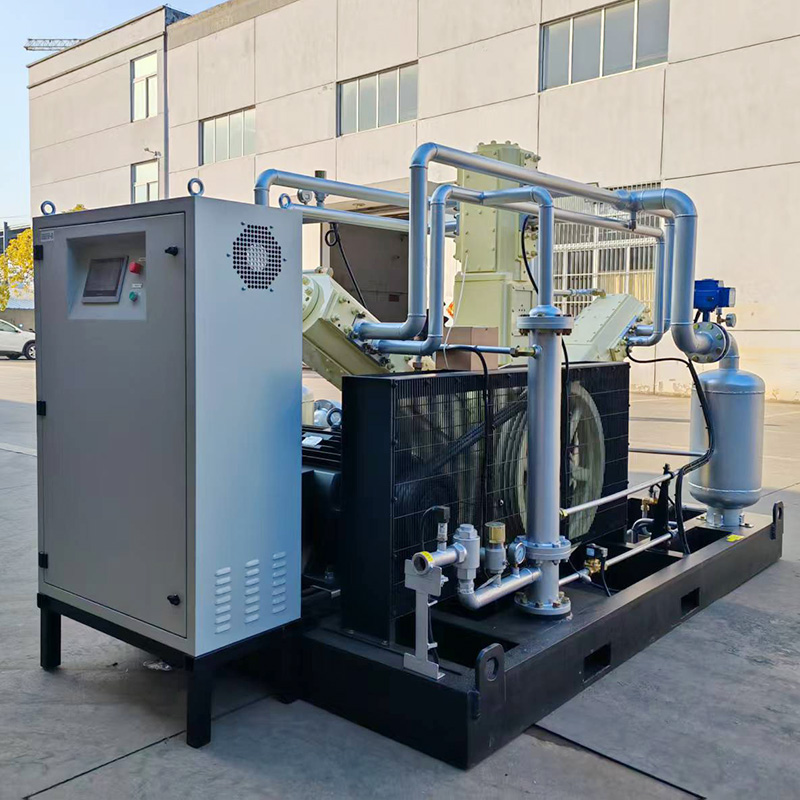
Currently, there is significant variation in how air compressors are specified in the market. In particular, domestic and international products often use different units for power ratings: domestic models typically use kilowatts (kW), while international products generally use horsepower (hp). Furthermore, the numbers displayed on many air compressors in the domestic market do not necessarily indicate the actual power output; in many cases, they simply represent the manufacturer’s product serial number. In this article, we will explore the common methods used to specify air compressor ratings.
I. Four Basic Specification Methods:
1. Specification by Motor Horsepower:
This approach was acceptable in the early stages of air compression technology. However, as technology has advanced, the actual air delivery (output capacity) can vary drastically—even when the same motor is used—depending on the operating pressure, the manufacturer, and the specific model size. Therefore, listing only the motor horsepower in a product catalog is highly misleading and irresponsible.
2. Specification by Piston Displacement:
Because this figure is derived directly from the compressor’s design specifications—calculated by multiplying the cylinder volume by the rotational speed—it is the easiest data to obtain and is frequently used by manufacturers for labeling. There is no fixed correlation between this theoretical value and the actual air output; the relationship depends entirely on the manufacturer’s technical capabilities.
3. Specification by Inlet Volume:
This method, typically measured at the air intake using an orifice meter, is currently used primarily to specify the capacity of centrifugal air compressors. It is expressed in units of ICFM (Inlet Cubic Feet per Minute). While this is more accurate than the first two methods, it does not account for internal losses, meaning the stated value remains higher than the actual air output.
4. Expressed in terms of "Free Air Delivery" (FAD):
This method involves measuring the airflow at the discharge side using an orifice-type flow meter. Due to its high accuracy, it has become the primary global standard—adopted by organizations such as ISO, ASME, and JIS—for determining the actual air output of an air compressor. However, some Japanese manufacturers may label their equipment with "FAD" while simultaneously noting it as a "nominal capacity." In such cases, it is generally understood that the stated FAD is not an actual measured value, but rather a design-based figure. Unfortunately, the existence of a standard is one thing, while its actual application is quite another; therefore, unless the manufacturer’s catalog explicitly specifies the standard used, the credibility of the stated value should be viewed with significant skepticism.